

- Read the following and answer any four questions from 1.1 to 1.5:
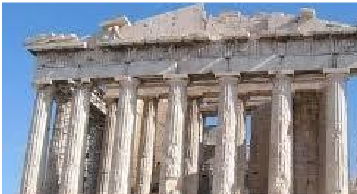
Marble’s popularity began in ancient Rome and Greece, where white and off-white marble were
used to construct a variety of structures, from hand-held sculptures to massive pillars and
buildings.
1.1 The substance not likely to contain CaCO3 is
a) Dolomite
b) A marble statue
c) Calcined gypsum
d) Sea shells.
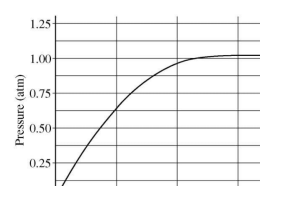
1.2 A student added 10g of calcium carbonate in a rigid container, secured it tightly and started
to heat it. After some time, an increase in pressure was observed, the pressure reading was
then noted at intervals of 5 mins and plotted against time, in a graph as shown below. During
which time interval did maximum decomposition took place?
a) 15-20 min
b) 10-15 min
c) 5-10 min
d) 0-5 min
1.3 Gas A, obtained above is a reactant for a very important biochemical process which occurs in
the presence of sunlight. Identify the name of the process –
a) Respiration
b) Photosynthesis
c) Transpiration
d) sphotolysis
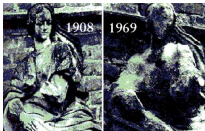
1.4 Marble statues are corroded or stained when they repeatedly come into contact with polluted rain water. Identify the main reason
a) decomposition of calcium carbonate to calcium oxide
b) polluted water is basic in nature hence it reacts with calcium carbonate
c) polluted water is acidic in nature he
d) calcium carbonate dissolves in water to give calcium hydroxid
1.5 Calcium oxide can be reduced to calcium, by heating with sodium metal. Which compound would act as an oxidizing agent in the above process?
a) Sodium
b) sodium oxide
c) calcium
d) calcium oxide
| Answer Key | 1.1 white precipitate is obtained 1.2 0-5 min 1.3 photosynthesis 1.4 polluted water is acidic in nature hence it reacts with calcium carbonate 1.5 calcium oxide |
******
- Read the following and answer any four questions from 2.1 to 2.5:
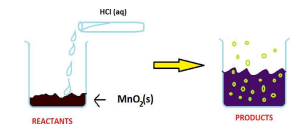
The reaction between MnO2 with HCl is depicted in the following diagram. It was observed that a gas with bleaching abilities was released .
2.1 The chemical reaction between MnO2 and HCL is an example of:
a) displacement reaction
b) combination reaction
c) redox reaction
d) decomposition reaction.
2.2 Chlorine gas reacts withMnO2 and HCL _________ to form bleaching powder.
a) dry Ca(OH)2
b) dil. solution of Ca(OH)2
c) conc. solution of Ca(OH)2
d) dry CaO
2.3 Identify the correct statement from the following:
MnO2 is getting reduced whereas HCl is getting oxidized
a) MnO2 is getting oxidized whereas HCl is getting reduced.
b) MnO2 and HCl both are getting reduced.
c) MnO2 and HCl both are getting oxidized.
2.4 In the above discussed reaction, what is the nature of MnO2 ?
a) Acidic oxide
b) Basic oxide
c) Neutral oxide
d) Amphoteric oxide
2.5 What will happen if we take dry HCl gas instead of aqueous solution of HCl?
a) Reaction will occur faster.
b) Reaction will not occur.
c) Reaction rate will be slow
d) Reaction rate will remain the same.
| Answer Key | 2.1(c) redox reaction 2.2(a) dry Ca(OH)2 2.3(a)MnO2 is getting reduced whereas HCl is getting oxidized 2.4(b) Basic oxide 2.5(b) Reaction will not occur |
- Read the following and answer any four questions from 3.1 to 3.5:
Chemistry in Automobiles:
For an internal combustion engine to move a vehicle down the road, it must convert the energy stored in the fuel into mechanical energy to drive the wheels. In your car,the distributor and battery
provide this starting energy by creating an electrical “spark”,which helps in combustion of
fuels like gasoline. Below is the reactiondepictingcomplete combustion of gasoline in full supply of air:- 2C8H18(I) + 25O2(g)——-> 16’x’
3.1 Which of the following are the products obtained from the reaction mentioned in the above
case?
Product ‘X’Product ‘Y’
a) CO2 H2O2
b) H2O CO
c) CH3OH H2O
d) CO2 H2O
3.2 Identify the types of chemical reaction occurring during the combustion of fuel:
a) Oxidation & Endothermic reaction
b) Decomposition & Exothermic reaction
c) Oxidation & Exothermic reaction
d) Combination & Endothermic reaction
3.3 On the basis of evolution/absorption of energy, which of the following processes are similar to combustion of fuel?
a) Photosynthesis in plants
b) Respiration in the human body
c) Decomposition of vegetable matter
d) Decomposition of ferrous sulphate.
(a) (ii) & (iii)
(b) (i) & (ii)
(c) (iii) & (iv)
(d) (ii) & (i)
3.4 ‘A student while walking on the road observed that a cloud of black smoke belched out from the exhaust stack of moving trucks on the road.’ Choose the correct reason for the production of black smoke:
a) Limited supply of air leads to incomplete combustion of
b) Rich supply of air leads to complete combustion of fuel.
c) Rich supply of air leads to a combination reaction.
d) Limited supply of air leads to complete combustion of fuel.
3.5 ‘Although nitrogen is the most abundant gas in the atmosphere, it does not
combustion’. Identify the correct reason for this statement.
a) Nitrogen is a reactive gas
b) Nitrogen is an inert gas
c) Nitrogen is an explosive gas
d) Only hydrocarbons can take part in combustion
| Answer Key | 3.1-(d) 3.2-(c) 3.3-(a) 3.4-(a) 3.5-(b) |
- Read the following and answer any four questions from 4.1 to 4.5
Frothing in Yamuna:
The primary reason behind the formation of the toxic foam is high phosphate content in the wastewater because of detergents used in dyeing industries, dhobi ghat and households
Yamuna’s pollution level is so bad that parts of it have been labelled ‘dead’ as there is no oxygen in it for aquatic life to survive.

4.1 Predict the pH value of the water of river Yamuna if the reason for froth is high content of
detergents dissolved in it.
a) 10-11
b) 5-7
c) 2-5
d) 7
4.2 Which of the following statements is correct for the water with detergents dissolved in it?
a) low concentration of hydroxide ion (OH– )and high concentration of hydronium ion (H3O+)
b) high concentration of hydroxide ion (OH– )and low concentration of hydronium ion (H3O+)
c) high concentration of hydroxide ion (OH–) as well as hydronium ion (H3O+)
d) equal concentration of both hydroxide ion (OH–) and hydronium ion (H3O+)
4.3 The table provides the pH value of four solutions P, Q, R and S
| Solution | pH value |
| P | 2 |
| Q | 9 |
| R | 5 |
| S | 11 |
Which of the following correctly represents the solutions in increasing order of their hydronium ion concentration?
a) P>Q>R>S
b) P>S>Q>R
c) S<Q<R<P
d) S<P<Q<R
4.4 High content of phosphate ion in river Yamuna may lead to:
a) decreased level of dissolved oxygen and increased growth of algae
b) decreased level of dissolved oxygen and no effect of growth of algae
c) increased level of dissolved oxygen and increased growth of algae
d) decreased level of dissolved oxygen and decreased growth of algae
4.5 If a sample of water containing detergents is provided to you, which of the following methods will you adopt to neutralize it?
a) Treating the water with baking soda
b) Treating the water with vinegar
c) Treating the water with caustic soda
d) Treating the water with washing soda
| Answer Key | 4.1 (a) 4.2 (b) 4.3 (c) 4.4 (a) 4.5 (b) |
- Read the following and answer any FOUR questions from 5.1 to 5.5 that follow on the basis of information provided and studied concepts.
A biogas plant is where biogas is produced by fermenting biomass.
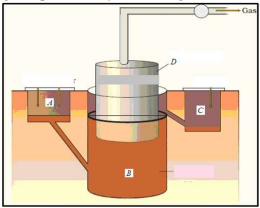
5.1 In which of the parts would you find anaerobic bacteria
a) A
b) B
c) C
d) D
5.2 Which one of the following is NOT correct for biogas
a) its carbon neutral
b) its non-renewable
c) it depends on micro-organisms
d) yields rich manure
5.3 Which of the following best indicates the steps of anaerobic digestion?
a) Waste watezr feed → biogas storage → generator → biogas
b) Waste water feed → digester → biogas → biogas storage → generator
c) Generator → waste water feed → digester → biogas → biogas storage
d) Waste water feed → biogas → digester → biogas storage → generator
5.4 Biogas is a better fuel than animal dung cake because
a) Biogas is a renewable source of energy
b) Animal dung cake has higher calorific value
c) Biogas has high heating capacity
d) Biogas burns without smoke.
i. (a) only
ii. (b) only
iii. (c) and (d)
iv. (a) and (b)
5.5 Biogas is formed in the
a) presence of air only
b) presence of water only
c) presence of air and absence of water
d) presence of water and absence of air
| Answer Key | 5.1 b) B 5.2 b) its non-renewable 5.3 (b) Waste water feed → digester → biogas → biogas storage → generator 5.4 (c) (iii) and (iv) 5.5 (d) presence of water and absence of air |
- Read the following and answer the questions any four from (i) to (v)
Food chains are very important for the survival of most species.
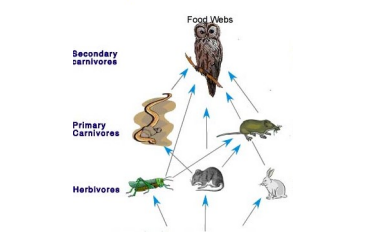
6.1 If 10,000 J solar energy falls on green plants in a terrestrial ecosystem, what percentage of
solar energy will be converted into food energy?
a) 10,000 J
b) 100 J
c) 1000 J
d) It will depend on the type of the terrestrial plant.
6.2 If Ravi is consuming curd/yogurt for lunch , which trophic level in a food chain he should be
considered as occupying ?
a) First trophic level
b) Second trophic level
c) Third trophic level
d) Fourth trophic level
6.3 The decomposers are not included in the food chain.The correct reason for the same is
because decomposers:
a) Act at every trophic level of the food chain
b) Do not breakdown organic compounds
c) Convert organic material to inorganic forms
d) Release enzymes outside their body to convert organic material to inorganic forms
6.4 Matter and energy are two fundamental inputs of an ecosystem. Movement of
a) Energy is bidirectional and matter is repeatedly circulating.
b) Energy is repeatedly circulation and matter is unidirectional.
c) Energy is unidirectional and matter is repeatedly circulating.
d) Energy is multidirectional and matter is bidirectional.
6.5 Which of the following limits the number of trophic levels in a food chain?
a) Decrease in energy at higher trophic levels
b) Less availability of food
c) Polluted air
d) Water
| Answer Key | 6.1 b) 100 J 6.2 c) Third Trophic level 6.3 a) Act at every trophic level of the food chain 6.4 c) Energy is unidirectional and matter is repeatedly circulating 6.5 a) Decrease in energy at higher trophic level |
- Read the following and answer the questions any four from (i) to (v)
Observe the food web and answer the questions given below –
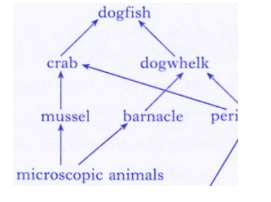
7.1 The mussel can be described as
a) Producer
b) Primary consumer
c) Secondary consumer
d) decomposer
7.2 Which trophic level is incorrectly defined?
a) Carnivores – secondary or tertiary consumers
b) Decomposers – microbial heterotrophs
c) Herbivores – primary consumers
d) Omnivores – molds, yeast and mushrooms
7.3 The given figure best represents:
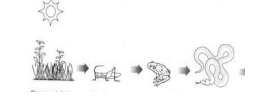
a) Grassland food chain
b) Parasitic food chain
c) Forest food chain
d) Aquatic food chain
7.4 Why do all food chains start with plants?
a) Because plants are easily grown
b) Because plants are nutritious
c) Because plants can produce its own energy
d) Because plants do not require energy
7.5 In the food web, what two organisms are competing for food?
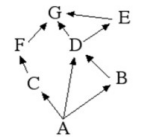
a) A and B c) A and C
b) D and F d) B and D
| Answer Key | 7.1 c)Secondary consumer 7.2 d) Omnivores – molds, yeast and mushrooms 7.3 a) Grassland food chain 7.4 c) Because plants can produce its own energy 7.5 d) |